
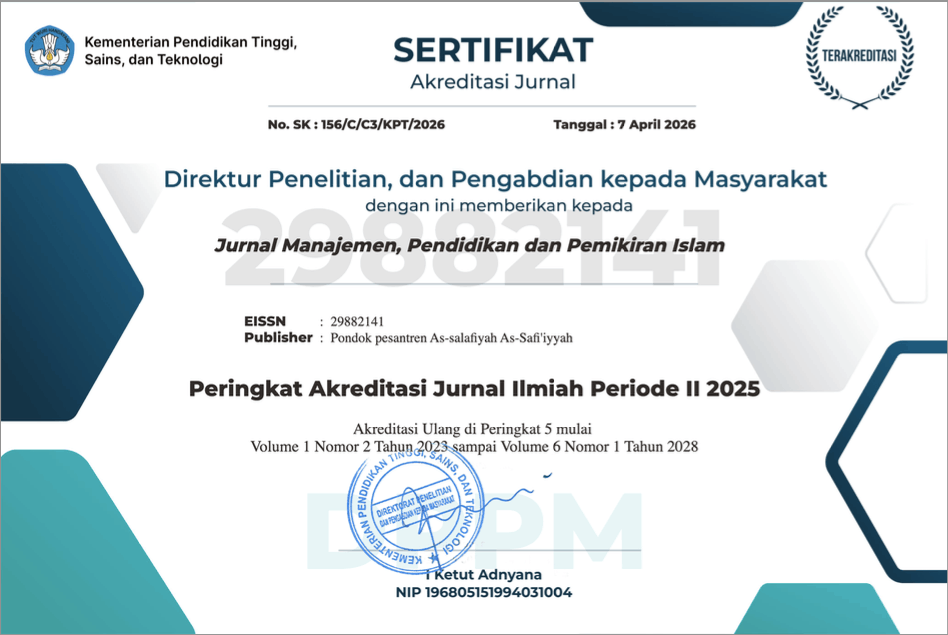

JMPI: Jurnal Manajemen, Pendidikan dan Pemikiran Islam applies a double-blind peer review process to ensure the quality, originality, relevance, and academic integrity of published articles. The identities of authors and reviewers are kept confidential throughout the review process. This process is conducted in accordance with recognized principles of publication ethics and the Principles of Transparency and Best Practice in Scholarly Publishing.
All submitted manuscripts are first examined by the editorial team to assess their alignment with the journal’s aims and scope, compliance with the author guidelines, academic relevance, originality, and general manuscript quality. Manuscripts may also be screened using plagiarism-detection software, such as Turnitin, to identify potential textual similarities.
Submissions that do not meet the journal’s basic requirements or fall outside its scope may be rejected at this stage or returned to the authors for revision before further consideration.
Manuscripts that pass the initial screening are assigned to at least two independent reviewers with relevant expertise in the subject area of the submission. Reviewers are selected based on their academic qualifications, research expertise, and suitability to evaluate the manuscript.
The journal applies a double-blind review system in which reviewers do not know the identities of the authors, and authors do not know the identities of the reviewers. Reviewers are expected to follow applicable principles of publication ethics.
Reviewers are requested to evaluate manuscripts based on the following criteria:
Relevance to the journal’s aims and scope.
Originality and contribution to the advancement of knowledge.
Adequacy of the theoretical framework and literature review.
Appropriateness of the research methodology.
Accuracy and clarity of data analysis and interpretation.
Quality of discussion and conclusions.
Compliance with academic writing and ethical standards.
Relevance and accuracy of references.
Reviewers provide constructive comments and recommendations to help authors improve the scholarly quality of their manuscripts.
Based on the reviewers’ reports and the editor’s assessment, the editorial team may make one of the following decisions:
Accept: The manuscript is accepted for publication without further substantive revision.
Minor Revision: The manuscript requires limited revisions before a final decision.
Major Revision: The manuscript requires substantial revisions and may be sent for further review.
Reject: The manuscript does not meet the journal’s standards or is unsuitable for publication.
The final decision rests with the editor, who considers the reviewers’ recommendations, the manuscript’s academic merit, and the journal’s publication standards.
Authors whose manuscripts require revision must address the reviewers’ and editor’s comments carefully. A revised manuscript should be accompanied by a response document explaining how each comment has been addressed. If a suggestion is not adopted, authors should provide a clear academic justification.
Revised manuscripts may be returned to the original reviewers for further assessment, particularly when major revisions have been requested. Manuscript submission and revision are managed through the journal’s Online Journal System (OJS).
All manuscripts and review reports are treated as confidential documents. Reviewers must not disclose, distribute, or use unpublished manuscript material for personal or professional advantage.
Reviewers are expected to declare any potential conflicts of interest and decline assignments when they cannot provide an impartial assessment. The editorial team is responsible for maintaining the integrity, fairness, and confidentiality of the review process in accordance with recognized publication ethics standards.
The duration of the review process may vary depending on reviewer availability, the complexity of the manuscript, and the extent of revisions required. The editorial team seeks to conduct the process efficiently while maintaining rigorous academic standards. Authors may monitor the status of their submissions through the journal’s OJS submission system.
Acceptance for publication is determined by the editorial team after considering the review reports and ensuring that the manuscript meets the journal’s scholarly, ethical, and technical requirements. Acceptance does not automatically guarantee immediate publication, as the manuscript may still undergo copyediting, layout, proofreading, and final production checks.
JMPI is committed to conducting a fair, transparent, confidential, and academically rigorous peer review process to maintain the quality and credibility of its publications.
ADDITIONAL MENU
SUBMIT ARTICLE

ARTICLE TEMPLATE

CTEDNESS IN SCOPUS

CTEDNESS IN SCOPUS






CTEDNESS IN SCOPUS

Contact us

TOOLS


INFORMATION
VISITORS


